Golf On Mars
- 4.5
- Rating
- 10.00K
- Installs
- $2.99
- Price

 Analysis by App-foxy
I went into Golf On Mars expecting a quick joke built around an unusual setting, but the game works better when I treat it as a small, focused sports experience rather than a full golf simulation. Its central idea is simple: take the familiar act of lining up a shot and place it somewhere that immediately feels different. That contrast gives the first sessions a pleasant sense of discovery, especially when I want something I can pick up without learning a complicated ruleset.
Captain Games presents this as a paid sports game, not as a social golf platform or a large competitive package. That distinction matters. I would recommend it to someone who enjoys compact games with a clear premise, while I would steer a player looking for licensed courses, online competition, or a deep career mode toward a more conventional golf title. The appeal here is the unusual atmosphere and the straightforward interaction, not an enormous amount of content.
What the first sessions feel like
The first-week appeal comes from how quickly the concept communicates itself. I do not need to spend much time understanding why the setting is amusing or what the game is asking me to do. The Mars theme gives ordinary golf actions a different mood, and that is enough to make an initially familiar activity feel fresh. It is the kind of game I can open during a short break, play a little, and close without feeling that I have abandoned a long session.
You May Also Like

 Blood Strike: 2.5 Anniversary
Blood Strike’s Loadouts Turn Every Drop Into a Tactical Gamble
A close look at Blood Strike’s custom loadouts: how fast access to signature weapons reshapes its battle royale rhythm, rewards preparation, and narrows the gap between fights.

 Pandora - Music & Podcasts
Pandora’s Music Is Easy to Start, but Harder to Recover
Pandora’s strength is its low-effort path from a seed to a station. Its weak spot is how much confidence it asks you to place in connection, setup, and quiet recovery.

 8 Ball Pool
 Is Built on Rivalries, Rematches, and Routine
A close look at the rivalries, rematches, shared routines, and unanswered safety questions that turn a quick pool match into a persistent mobile community.

 Samsung Music
’s Quiet Strength Is Playing What You Already Own
Its reach comes less from spectacle than from dependable access to a personal library. That simplicity is both the app’s strongest retention engine and its ceiling.

 AccuWeather: Weather Radar
AccuWeather Review: A Quick, Clear Forecast for Everyday Decisions
For everyday plans, the best forecast is the one you can understand quickly. AccuWeather makes rain timing, radar, and local conditions easy to act on, with a few trade-offs.

 Hill Climb Racing
Why Hill Climb Racing Still Turns Crashes Into One More Run
A tiny car, a bumpy hill and one more upgrade: Hill Climb Racing keeps resurfacing because its simple chaos makes every near-miss feel personal.
More From Our News Desk



That accessibility also makes the Everyone age rating a natural fit. I can imagine younger players enjoying the space setting, while adults may appreciate the game as a low-pressure diversion. The tone is approachable rather than intimidating, and the basic premise does not depend on a large amount of background knowledge. If someone has never played a golf game before, this is less demanding than a simulation that expects an understanding of clubs, lies, wind, and tournament strategy.
My strongest early impression was that the game benefits from restraint. It does not need to explain the premise repeatedly. Once the novelty of golf on another world has landed, the pleasure comes from trying to make cleaner decisions and seeing whether a shot develops as planned. That makes the first sessions satisfying without requiring a long tutorial or a large investment of time.
There is also a useful difference between playing it casually and playing it carefully. A quick player can approach each shot instinctively, but a more deliberate player can pause, inspect the situation, and think about risk. I found that this gave the game more texture than the store summary suggests. The setting attracts attention, but the small decisions are what determine whether I want another attempt.
Who gets the most from the premise
I think the best audience is someone who likes minimalist sports games, quirky themes, and short sessions. It suits a commute, a waiting room, or the few minutes before bed when I want an activity rather than passive scrolling. The paid price of $2.99 also places it in a different mental category from a free game designed to keep me returning through constant prompts. I am buying a contained experience, so I judge it by how enjoyable its core loop remains rather than by how many ongoing systems it offers.
That same focus may disappoint players who expect the breadth normally associated with established golf games. If your ideal experience includes a large roster of courses, detailed player development, online rivals, or a long stream of unlocks, this is probably not the right choice. The Mars idea will not compensate forever for missing depth if you need a game to occupy you every day for months.
One practical tip improved my early sessions: I stopped treating every shot as something to rush. Even in a compact game, taking a moment to read the situation makes the interaction feel more like golf and less like tapping through a novelty. The unusual setting is the invitation, but patience is what makes the mechanics worth revisiting.
Why the novelty can last beyond the first week
After the initial surprise fades, the question becomes whether the game has enough repeatable decision-making to stand on its own. In my experience, its lasting value depends heavily on what I want from a mobile game. If I enjoy replaying a compact challenge and refining my approach, the simplicity is a strength. If I need frequent new content, social goals, or a visible progression ladder, the same simplicity becomes a limitation.
I would not describe it as a game that demands a daily habit. Instead, it works well as a reliable occasional game. I can return when I want a short sports-themed break, and I do not have to remember a complex story, maintain a team, or recover from missing a timed event. That low commitment is valuable. It means the game remains easy to revisit after several days away.
The trade-off is that a relaxed return pattern can also reveal the boundaries of the experience. A game with fewer layers has fewer reasons to pull me back when the central activity is no longer surprising. The Mars setting gives the opening sessions personality, but it cannot carry every return by itself. Long-term enjoyment therefore comes from whether I like the act of playing, not simply from liking the idea behind it.
For an everyday scenario, I can see myself using it after finishing work, when I have enough attention for a game but not enough energy for a complicated one. I might play a few holes, experiment with a safer approach, and stop before the session becomes a commitment. That is a genuine use case, but it is different from saying the game can replace a full-featured golf title. It fills the space between a quick arcade distraction and a serious simulation.
How it compares with ordinary golf alternatives
Compared with a traditional golf simulation, Golf On Mars is easier to approach and less likely to make me feel that I need to study the sport before enjoying it. A simulation usually wins on realism, equipment choices, course variety, and detailed performance management. This game wins when I want the recognizable shape of golf without all the administrative weight around it.
Compared with a free-to-play mobile golf game, the paid model is appealing because the experience feels more self-contained. I am not approaching it as a service that must constantly compete for my attention. That can make short sessions feel cleaner. On the other hand, free alternatives may offer more visible progression, more frequent challenges, and stronger reasons to return if those systems are what motivate me.
It also differs from a pure arcade game. The Mars theme is playful, but the golf premise still encourages me to think about placement and consequences rather than simply reacting as fast as possible. I would choose it over a faster arcade alternative when I want a calmer pace and a little more room for planning. I would choose the arcade alternative when I want immediate action with almost no pause between attempts.
A useful way to decide is to ask what I want the setting to do. If I want a memorable hook wrapped around a compact golf game, this is a good match. If I want the setting to be supported by a large science-fiction world, story, exploration, or simulation detail, I should adjust my expectations before paying for it.
Maintenance, friction, and the cost of returning
One of the quiet strengths of a small paid game is that it does not ask me to maintain much outside the play session. I do not need to organize a roster, check in for rewards, or remember a long chain of tasks. That makes it suitable for irregular play. I can leave it alone and come back later without feeling that I have fallen behind.
The maintenance burden is therefore mostly personal: keeping the game installed, remembering why I enjoyed it, and accepting that its value comes from the core activity. The current version is 1.0.11, and the minimum requirement is Android 5.0, which makes it accessible to a broad range of Android devices. I would still check that my phone has enough free space and that its controls feel comfortable before settling into longer sessions, because a small game can be less enjoyable if the screen or touch response makes precision awkward.
The game has a 4.5 average from around 358 ratings, with over 67 written reviews and more than 10K installs. Those figures suggest that the concept has found an audience, but I would not use popularity alone as proof that it will suit me. A compact game can receive positive reactions because its premise is charming, while an individual player may still find the repeat value too limited. The important question is whether I enjoy replaying the shots after the first laugh has passed.
The price changes the way I evaluate friction. At $2.99, I do not expect the scale of a premium console golf game, but I do expect the central interaction to feel worthwhile without needing a long explanation. If I encounter a control issue or a moment where the game feels less clear than it should, there is no large free package surrounding that weakness. The smaller the game, the more visible each rough edge becomes.
For that reason, I would advise playing with a deliberate mindset rather than expecting a content marathon. Think of the purchase as paying for a distinctive, focused game that can live on the phone as an occasional option. That expectation makes the experience easier to appreciate and prevents an unfair comparison with much larger products.
Where fatigue may appear
The main source of fatigue is repetition without a strong personal goal. Once I understand the basic attraction, I need to supply my own reason to continue. That might be improving a poor attempt, testing a different approach, or simply enjoying the unusual atmosphere. Players who depend on constant rewards or a steady stream of new objectives may feel the experience becoming familiar sooner than they would like.
Another possible friction point is the gap between the title’s promise and the depth a player may imagine from it. “Golf on Mars” is an excellent hook, but it can lead me to expect a broad combination of golf and science fiction. If I arrive looking for a richly developed planetary setting, the focused design may feel smaller than anticipated. I see that as an expectation problem rather than a reason to dismiss the game, but it is worth considering before purchase.
Short-session games can also create an odd kind of indecision: they are easy to open, yet not always compelling enough to become a firm habit. I may enjoy a session and then forget about the game for a week. That is not necessarily a flaw if I want a casual diversion, but it matters if I am searching for one main mobile game to play every day.
My practical solution is to use it as part of a small rotation. I would keep it alongside a deeper sports game, a puzzle game, or something story-driven. In that role, its limited scope becomes useful instead of disappointing. It provides a different pace and mood, and I do not ask it to supply the variety that another game is better equipped to provide.
Who should buy it and who should skip it
I would recommend it to players who enjoy a clear gimmick backed by an uncomplicated sports activity. It is especially suitable if you want a paid Android game that can be played in short bursts, has an Everyone rating, and does not require you to commit to a large ongoing system. The developer, Captain Games, has chosen a premise that is immediately understandable, and that clarity is a major part of the experience.
I would be more cautious if you are buying specifically for long-term progression. The game may remain enjoyable for a player who likes repeating a focused challenge, but I would not purchase it expecting the same depth as a major golf simulation. I would also skip it if the Mars setting is the only thing that interests you and you need a substantial science-fiction world around the sport. The title creates curiosity; it does not automatically promise a complete planetary adventure.
Before buying, I would ask myself three questions. Do I enjoy golf mechanics even when they are presented in a compact form? Am I comfortable with a game whose replay value depends on my own interest rather than a large collection of external goals? And do I prefer paying once for a focused experience over trying a free alternative with more ongoing activity? My answers would tell me more than the rating or install count.
My long-term verdict
Golf On Mars earns a place as an occasional game, not necessarily as a permanent daily habit. Its strongest qualities are the instantly recognizable premise, the approachable sports format, and the low maintenance required to return after a break. I like that it can offer a little personality without asking me to manage a large game world or learn an elaborate system.
Its lasting value is more conditional than its first impression. The novelty of the setting will naturally weaken, and the game then depends on whether I find the underlying golf decisions satisfying enough to repeat. For me, that makes it a better companion title than a single all-purpose mobile game. I can return when I want something focused, unusual, and easy to fit into an ordinary day.
At $2.99, I think the purchase makes sense for the right player: someone seeking a compact, paid sports game with a memorable twist. I would not recommend it as a substitute for a detailed golf simulator or a content-heavy free-to-play game. But if the idea of making golf feel strange, light, and pleasantly self-contained appeals to you, this is one of those small games that can remain useful after the initial joke has worn off.
My final advice is to buy it for the quality of the short session, not for an imagined endless future. When I judge it on that basis, the game’s focused design becomes its reason to exist. It does not need to dominate my phone to justify itself; it only needs to be the right answer when I want a few thoughtful swings in an unexpectedly distant setting.
FAQs for Golf On Mars
01What is Golf On Mars?
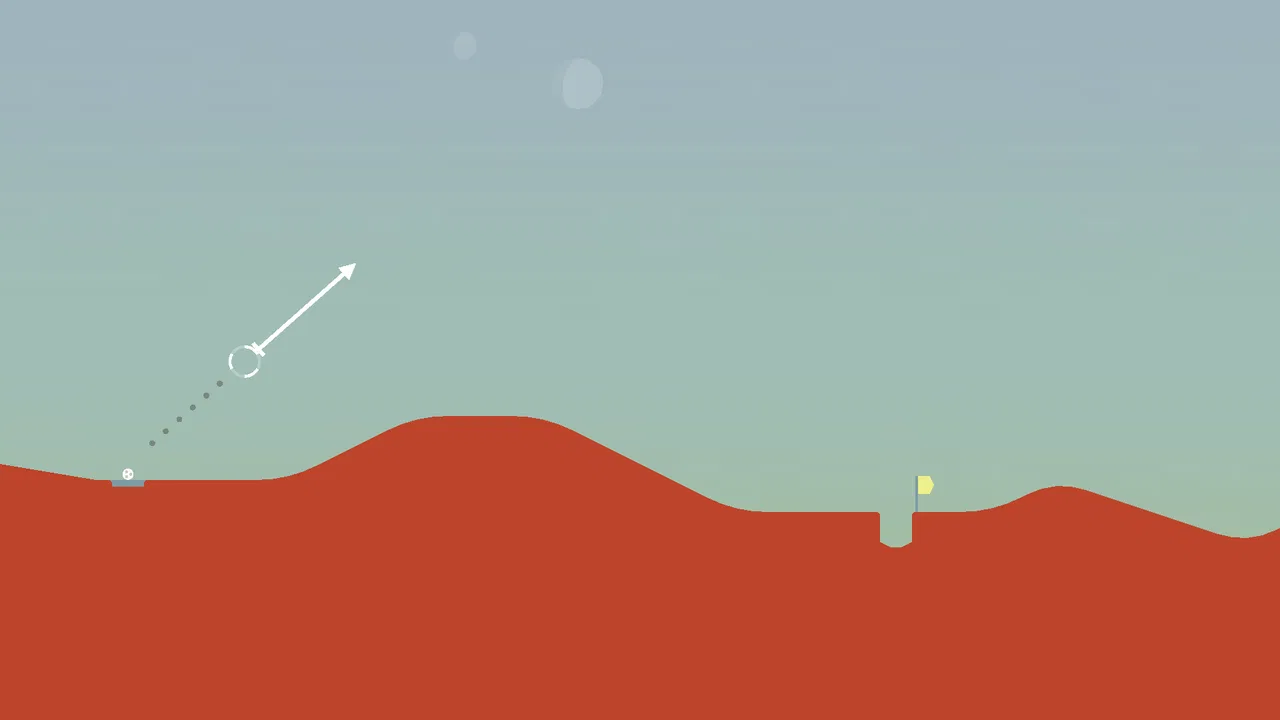
Golf On Mars is a minimalist golf game set on the surface of Mars. Instead of traditional courses, it presents procedurally generated terrain with hills, craters, and uneven landscapes. The main objective is simple: hit the ball toward the hole using as few strokes as possible. Its quiet presentation and unusual setting make it feel more like a relaxing exploration game than a conventional sports title.
02How does the gameplay work in Golf On Mars?
The controls are designed to be easy to understand, but the terrain makes each shot challenging. You generally aim by adjusting the direction and control the strength of your swing before launching the ball. Mars’ low-gravity environment and irregular ground can send the ball farther than expected, so successful play depends on judging slopes, planning rebounds, and learning from previous attempts rather than simply hitting the ball directly at the hole.
03Is Golf On Mars suitable for casual players?
Yes. Golf On Mars is well suited to casual players because it does not require complicated controls, fast reactions, or long sessions. You can play a few holes whenever you have time, and the slow pace makes it a comfortable choice for relaxing. However, the game can still be demanding because unpredictable terrain and unusual ball physics require patience, experimentation, and careful shot planning.
04Does Golf On Mars include ads, in-app purchases, or online multiplayer?
The available version and platform may determine whether Golf On Mars includes advertising, purchases, or other monetization features, so it is worth checking the official store listing before downloading. The experience is primarily focused on solo play and personal score improvement rather than competitive online multiplayer. Players looking for tournaments, social features, or a full career mode should review the current app description to confirm what is supported.
05Does Golf On Mars work offline, and what devices support it?
Golf On Mars is generally designed as a self-contained mobile game, making it a good option for playing during commutes or in places without a reliable internet connection. Nevertheless, an internet connection may be needed for the initial download, updates, or store-related services. Compatibility depends on your Android or iOS version and device hardware, so check the official download page for the latest requirements before installing.
Pros
- Relaxing low-gravity golf creates a distinctive
- enjoyable experience.
- Simple controls make it easy to play with one hand.
- Mars landscapes give every hole a memorable visual identity.
- Short rounds are well suited to quick gaming sessions.
- Minimalist presentation keeps the focus on putting and exploration.
Cons
- Low gravity can make shots feel unpredictable at first.
- The gameplay may become repetitive after extended sessions.
- Limited competitive features reduce long-term replay value.
- Some holes require trial and error rather than clear strategy.
- The sparse visuals may feel too basic for players wanting realism.

Golf On Mars
Gallery